 Onlinebrückenkurs Mathematik
Chapter 3 Inequalities in one Variable
Section 3.3 Absolute Value Inequalities and Quadratic Inequalities3.3.2 Quadratic Absolute Value Inequalities
Hence, quadratic inequalities can be solved in two ways: by investigating the roots and the orientation behaviour of the polynomial (i.e., whether the parabola opens upwards or downwards) and by completing the square. Often completing the square is simpler:
Info 3.3.5
To solve an inequality by completing the square one tries to transform it into the form . Taking the square root then results in the absolute value inequality with the solution set if . If , the inequality is unsolvable.
The inverted inequality has the solution set . For and the corresponding boundary points have to be included.
Always note the calculation rule described in Module 1.
Example 3.3.6
Find the solution of the inequality . Collecting the terms on the left-hand side and dividing the inequality by results in . Completing the square on the left-hand side to the second binomial formula results in the equivalent inequality or , respectively. Taking the square root results in the absolute value inequality with the solution set .
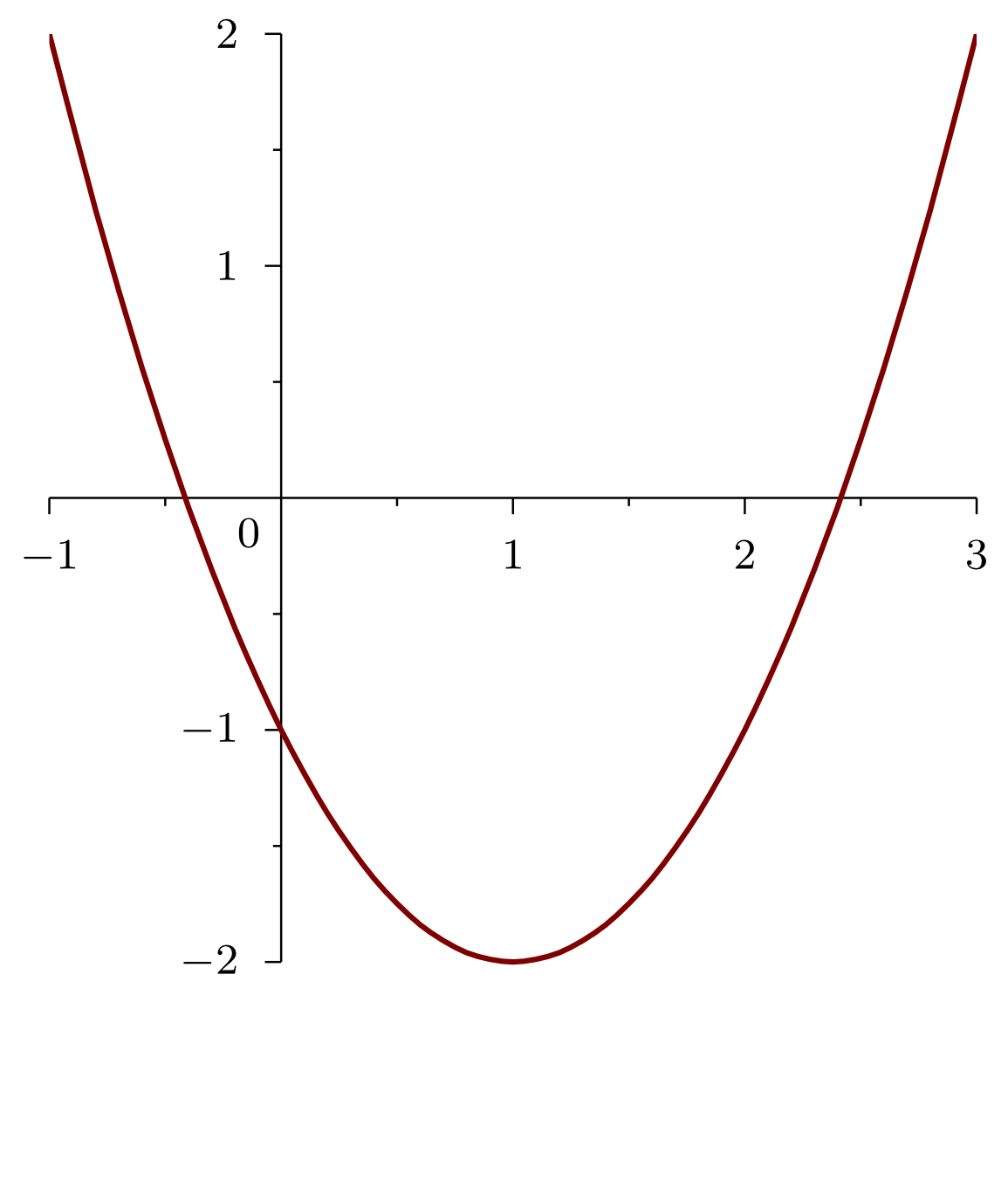
On the other hand, the inequality can be investigated as follows: The left-hand side describes a parabola opened upwards. The roots can be found using the formula:
Since the parabola opens upwards, the inequality is satisfied by the values of in the parabola branches left and right to the roots, i.e. by the set .
Info 3.3.7
Depending on the roots of , the orientation of the parabola and the comparator, the quadratic inequality (including other comparators) has one of the following solution sets:
- the set of real numbers ,
- two branches (including the boundary points for and ),
- an interval (including the boundary points for and if applicable),
- a single point ,
- the pointed set ,
- the empty set .
Fill in the blanks in the following text describing the solution of a quadratic inequality by investigating the behaviour of the parabola:
Exercise 3.3.8
Find the solution set of the inequality . Transformation results in the inequality
. Using the formula one obtains the set of roots
. The left-hand side describes a parabola opening
. It belongs to an inequality involving the comparator , hence the solution set is
.
. Using the formula one obtains the set of roots
. The left-hand side describes a parabola opening
. It belongs to an inequality involving the comparator , hence the solution set is
.
